
Oilfield & trucking shop, yard & warehouse financing.
Financing for the businesses that keep the oil patch moving — oilfield service shops, trucking terminals and fleet yards, plus the manufacturers and warehouse operators using the same buildings across Alberta, northeast BC, and Saskatchewan. The mortgage on the shop, plus the operating line, the cards, the leasehold improvements and the equipment that come with buying it, and a clean-up of what the company already owes. Owner-occupied or investment.
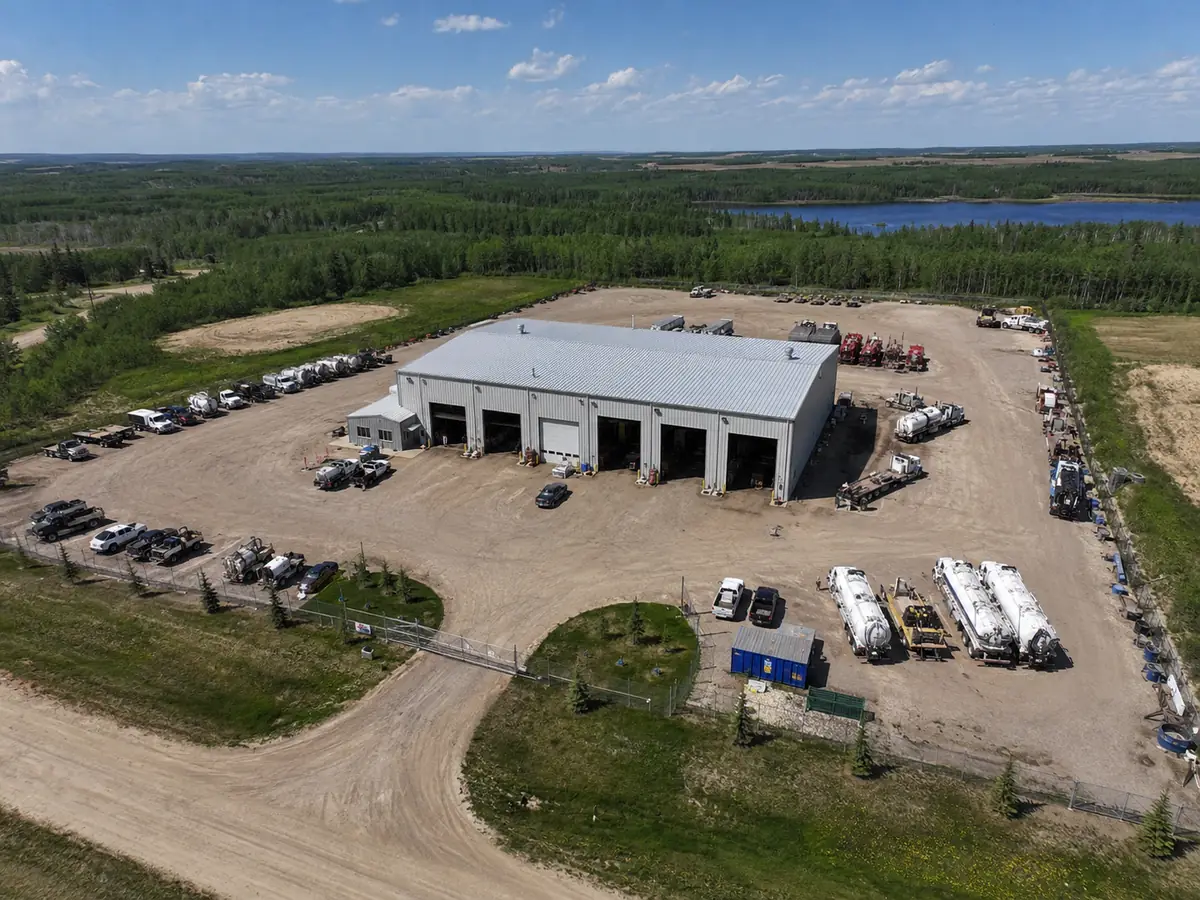
An oilfield service shop and yard is a specialized asset — single-industry income, small-town or remote locations, and environmental factors that make most bank branches nervous. Drive through Clairmont's industrial parks outside Grande Prairie and you'll see the asset class street after street: truck shops with drive-through bays, heavy-duty repair shops, fenced gravel yards — and barely a house in sight. We place these files for a living: matching the shop, the yard, and the operator to the handful of banks, credit unions, and private lenders that actually understand oil-patch real estate. The same lender lanes fund trucking terminals, fleet yards, manufacturing plants, and warehouses — same buildings, same underwriting, same small-town challenges. If your bank passed on the shop, start here.

Shops, yards, and the sites in between.
The typical file looks like the buildings you see across Clairmont, Nisku, and the Hat: a 110-ft shop with three to six drive-through bays, a wash bay, the company's own trucking bays, office space with a parts mezzanine above — all on one to ten acres of fenced, gravelled yard.
Shops for well servicing, wireline, coil, hydrovac, pressure, rental, frac-sand hauling, fluid and water hauling, and oilfield trucking companies.
Shops and yards for crane, picker, bed-truck, and winch-tractor fleets — plus lowbed, multi-axle, and pilot operations.
Fenced, gravelled and serviced yards for pipe, iron, equipment, and frac-sand storage or transload.
Truck and rig parking, dispatch and cross-dock space, wash bays, and maintenance shops for highway and vac-truck fleets.
Heavy-duty truck and equipment repair shops — Super-B-friendly 110-ft drive-through bays, overhead cranes, and welding/fabrication space.
Production space, warehousing, and distribution buildings — plus industrial strata bays in Nisku, Clairmont, Acheson, and beyond.
The building your service company operates from — financed on the business, not just the property.
Camp, lodge, and crew-accommodation assets tied to resource projects.
CNC and machine shops for downhole tools and pump parts, plus sandblasting bays and paint booths.
Mat manufacturing, rental fleets, and mat storage yards.
Shops and yards for oilfield general contractors — dirt work, pads, lease roads, and gravel fleets.
Truck and trailer sales lots, parts warehouses, and commercial tire bays.
Vac and waste transfer, bin yards, and oilfield waste-management facilities.
Dealerships, repair shops, and yards for ag equipment, custom harvesting, grain and livestock hauling, and seed or fertilizer retail — the same buildings, farm side.
Assets in resource towns most lenders won't touch — our specialty.
The whole financing package, not just the building.
When an oilfield service company buys its premises, the mortgage is one piece. We read the financials first, and more often than not the operating line is too small for the business, the credit cards are too small for the month, the purchase comes with leasehold improvements nobody has planned to fund, the equipment sits on a handful of loans at a handful of rates, and there is a tax balance or a supplier that has waited too long. All of it, and whatever else the statements show, is arranged as one package with one set of approvals, so the day the business owns the shop and yard it is not starved of working capital.
The anchor: the shop and yard, underwritten on the business that will run from it, with the lender lanes compared below.
Reading the financials usually shows the line of credit was sized years ago for a smaller company. It is resized in the same package: arranged with the lender financing the building, or kept where it is and raised where that bank will do it.
Fuel, parts, travel and suppliers run on cards, and an operating card that maxes out every month is a cash-flow problem dressed as a convenience. Limits are set to the business, not to a branch default.
The wash bay, the extra drive-through bays, the overhead crane, the parts mezzanine, the yard gravel and fencing: the work that turns a bought building into your shop. Funded as a leasehold-improvement loan beside the mortgage instead of out of the company's cash, so the purchase does not drain the money the business needs to operate.
The vac trucks, the picker, the service units and the shop tools. New equipment is financed alongside the building through our equipment-finance partners, and the down payment on it often comes out of the real estate.
We go through every loan, lease and card the business already pays: the old equipment loans, the vendor financing, the line opened in a tight year. Where consolidating them into the package lowers the monthly outlay, it is done at the same time, and the cash flow that frees is often the biggest saving in the whole file.
A CRA balance that fell behind, GST or payroll remittances in arrears, suppliers waiting on aged invoices: where the financials show them, they can be paid out from the package so the slate is clean on funding day.
That is the usual list, not the whole one. Whatever else the financial statements show that is costing the business cash flow it does not need to spend goes on the table in the same read.
Seen on a real file: a childcare operator opening its third centre, where the branch offered a $2,000 card increase and the same bank's commercial division approved roughly $1.1 million. Read the case study →
Three ways to fund an oilfield property.
The right lane depends on your financials, the location, and the timeline. We size every file against all three before recommending one.
Cheapest capital. Needs full financials, an environmental Phase I (fuel, wash bays, historic use), and net-worth/liquidity coverage. The key is a regional lender with genuine oil-patch appetite — most big banks decline single-industry, small-town assets.
Blends the company's cash flow with the real estate so a growing service business can own its premises instead of renting. CSBFP/SBL programs can extend leverage on qualifying owner-occupied deals.
For deals a bank can't close fast enough or won't touch — a remote town, a service company between contracts, or a site needing cleanup or lease-up. Paid out by a refinance to conventional or a sale once stabilized.
Rates, ratios, and leverage are typical ranges for illustration and depend on the asset, the operator, and market conditions. Run the numbers with our commercial mortgage payment calculator and cap rate calculator, then we confirm your file's numbers in writing.
Oilfield towns across AB, BC & SK.
Based in Metro Vancouver and financing oil-patch real estate right across Western Canada — from the Peace to the oil sands to the southeast Saskatchewan fields.
Don't see your town? If it's in the Western Canadian oil patch, we can almost certainly help — just ask.
Common oilfield-financing questions.
Can I get a mortgage on an oilfield shop and yard in Alberta or BC?+
Yes. Financing for oilfield service shops, equipment yards, laydown, and industrial sites is available across the Alberta, northeast BC, and Saskatchewan oil patch — owner-occupied or as an investment. The keys are the operator's financials, the property's condition and environmental profile, and finding a lender with genuine oil-patch appetite, which is exactly where a specialist broker earns their keep.
How much down payment do I need for an oilfield commercial property?+
Conventional lenders typically want 25–35% down (65–75% loan-to-value): closer to 25% on owner-occupied premises and around 35% on a pure yard or industrial site. Private capital can stretch to roughly 65–75% of value when speed or location rules out a bank.
Why do banks decline oilfield shop and yard mortgages?+
Three reasons usually: single-industry income tied to the oil cycle, small-town or remote locations with thin sales comparables, and environmental exposure (fuel storage, wash bays, historic industrial use). None of these are dealbreakers — they just need a lender who understands the asset and a clean environmental story, which we help put together.
Do I need an environmental report (Phase I / Phase II)?+
Almost always a Phase I Environmental Site Assessment, and sometimes a Phase II if the Phase I flags fuel, chemical, or historic-use risk. Above-ground fuel tanks, wash bays, and prior industrial activity are common triggers. We line this up early because it usually sets the closing timeline.
Can I finance the shop on my business's income instead of a tenant?+
Yes — that's an owner-occupied commercial mortgage. The lender blends your oilfield service company's cash flow with the property (and any yard-lease income) so a growing operator can own its premises rather than rent. CSBFP/SBL programs can extend leverage on qualifying owner-occupied deals.
We're buying the shop, but our operating line and credit cards are too small for the business. Can that be fixed in the same deal?+
Usually, and it should be. Going through the financials before the mortgage is even structured, we often find the operating line was sized years ago for a smaller company, the operating credit card maxes out every month, and the purchase comes with leasehold improvements, the wash bay, the extra bays, the yard, that nobody has planned to fund. We arrange the whole package together: the mortgage on the shop, an operating line and cards sized to the business you are running now, a leasehold-improvement loan beside the mortgage so the build-out does not come out of working capital, and the equipment financing, placed through our equipment-finance partners. The same read covers what the company already owes: the truck and equipment loans, the leases and the cards are consolidated where that lowers the monthly outlay, and an overdue CRA balance or aged payables can be paid out at funding, so the business moves into its shop with a clean slate.
Do you finance trucking terminals, manufacturing, and warehouse buildings too?+
Yes. Trucking terminals, fleet yards, cross-dock and dispatch facilities, manufacturing plants, and warehouses use the same buildings and the same lender lanes as oilfield shops — bank/credit-union conventional, owner-occupied on the business's cash flow, or private capital. If your company runs trucks or production out of a shop with a yard, the financing works the same way.
Can you finance in remote or small oil-patch towns?+
Yes — remote and small-town assets are a core part of what we do. From Grande Prairie and Fort St. John to Fort McMurray, Nisku, Estevan, and beyond, we work with regional lenders and private capital that will fund locations the big banks won't.
How long does an oilfield commercial mortgage take to close?+
Plan on 45–75 days for a conventional commercial mortgage — the environmental Phase I and appraisal usually set the pace — and 10–25 days for a private bridge with an appraisal already in hand.
Financing an oilfield property? Have these ready.
A complete package gets a term sheet weeks faster. Forward this list to your accountant, or have them call us directly.
- Last 2 years financial statements — property and the operating oilfield service company
- Current rent roll or yard-lease agreements (if any tenants)
- T1s/T2s and Notices of Assessment for all sponsors / guarantors
- Personal net-worth statement per sponsor
- Environmental Phase I (and Phase II if required) — we can order
- Recent commercial appraisal — we can order
- Purchase contract or existing mortgage payout statement
- Corporate structure / org chart (holdco / opco)
- Site-services summary — power, water, fencing, gravel, fuel storage, wash bays
Bank passed on the shop? Start here.
Tell us about the property and the operator — owner-occupied or investment, anywhere in the Western Canadian oil patch — and we'll tell you quickly which lane fits.